
In partnership with

Where geopolitics, markets, and technology meet, and where the most important shifts happen between systems, not inside them.
This week, three stories belong together. In Washington, the FCC moved against ABC and the Justice Department indicted James Comey on the same day, turning a joke and an old post into a licensing case and a federal charge. In the Gulf, the UAE walked out of OPEC in the middle of a war-driven energy shock. In Beijing, regulators blocked Meta's acquisition of Manus while Huawei's chips became the substrate for China's most advanced AI model.
Three stories, one pattern. Media, justice, energy, technology, all merging into a single field of power.
Cenk Sidar

Two Targets, One Afternoon
On April 28, the Trump administration moved against two targets in a single day. The FCC ordered Disney to file early license renewals for its eight ABC-owned TV stations by May 28 — years ahead of schedule — tying the move to an investigation into Disney's DEI practices. The timing said more: it came a day after President Trump called for ABC to fire Jimmy Kimmel over an April 23 joke about Melania Trump appearing as "an expectant widow," made two days before a gunman opened fire at the White House Correspondents' Dinner.
Hours later, the Justice Department indicted former FBI Director James Comey for a May 2025 Instagram post showing seashells arranged as "86 47," charging him with threatening the president. One regulator, one prosecutor, two longstanding Trump critics — moved against on the same afternoon.
Disney said it will comply and defend its record. FCC Commissioner Anna Gomez called the order "the FCC's most egregious attack on the First Amendment to date.” Comey surrendered and appeared in court.

This is the playbook of an authoritarian leader. It is not really about Kimmel. It is not only about Comey. It is about something larger.
What we are watching is the slow conversion of the American state into an instrument of personal grievance. Trump is using the machinery of government, licensing agencies, the Justice Department, tax authorities, regulatory threat, to punish critics and reward loyalists. This is not new in contemporary authoritarian world.
It is exactly what Putin did in Russia after 2000, what Orbán perfected in Hungary after 2010, what the AKP Government built in Turkey, what Chávez constructed in Venezuela. The pattern is consistent. You do not need to suspend the constitution. You only need to capture the institutions that enforce it.
The mechanism is always the same. Tax investigations land on opposition businessmen. Broadcast licenses get reviewed when networks run unflattering coverage. Prosecutors find old social media posts and turn them into federal cases. Universities, law firms, foundations, anyone with institutional weight, get pulled into compliance proceedings. The goal is not to win every case. The goal is to make the cost of disagreement high enough that most people stop disagreeing.
Institutions rarely break in one dramatic moment. They erode through incentives. When government signals that regulatory favor may depend on political alignment, the calculus inside companies shifts. The question stops being what serves the audience and becomes what avoids retaliation. Power does not need to be fully used to become effective. It only needs to be seen as available. Orbán understood this. Putin understood this. Trump understands it now. He learned from them.
Even if Disney wins the underlying review, the process itself is the punishment. License reviews take years and cost real money to defend. The license has entered the political battlefield, and that is the point. The Comey indictment works the same way. Whether or not it survives in court is secondary. The signal it sends to every other potential critic is the actual product.
The real story is institutional, and the United States is starting to look like countries Americans used to lecture.
Abu Dhabi Goes It Alone
On April 28, the United Arab Emirates announced it will leave OPEC and OPEC+ on May 1, ending nearly six decades of membership. The UAE was OPEC's third-largest producer, with capacity of about 4.85 million barrels per day and plans to reach 5 million by 2027. Energy Minister Suhail Al Mazrouei said the UAE did not consult Saudi Arabia before deciding.
The timing is shaped by the Iran war. With the Strait of Hormuz constrained, OPEC production fell 27 percent in March, the steepest collapse for the group in decades. Quotas have become meaningless because no one can ship at quota levels anyway. Before the war, the UAE was producing roughly 30 percent below its capacity to stay within OPEC limits.
The exit removes one of only two OPEC members with meaningful spare capacity. Saudi Arabia is now the sole swing producer.
This is not an oil story. It is a story about the international system coming apart at the seams. OPEC was one of the last functioning coordination mechanisms in global markets. It was not loved, and it was not always effective, but it was a structure where states agreed to constrain themselves for a shared outcome. That kind of discipline is disappearing across the board. The UN does not work. The WTO does not work. NATO is straining. (Or being destroyed?) Climate commitments are being walked back. Now even a producer cartel cannot hold its members together.
What is replacing it is a wild wild world system, where middle powers act on their own terms and stop waiting for permission. The UAE is the clearest example, but it is not alone. India is buying Russian oil, hosting Western tech, and refusing to pick a side. Saudi Arabia is hedging between Washington and Beijing. Brazil is reviving non-alignment. Indonesia, the Gulf states, South Africa, all of them are stepping into the space the old order used to occupy. The real story is not that the UAE left OPEC. It is that the institutions that once disciplined state behavior, in oil and beyond, are losing their grip. Middle powers are reading the moment correctly. The age of coordination is giving way to the age of positioning.
The boring Bitcoin strategy that works

Imagine it's 2031. Markets have been chaotic for years. Your coworkers are stressed. You're not. Because five years ago, you did something boring. You opened YieldClub, turned on Autopilot, and your yield started converting into Bitcoin every day. Quietly. Automatically. YieldClub earns up to 12% APY and routes your yield into Bitcoin automatically. No lockups, no guesswork.

When AI Sovereignty Moves Up the Stacker.
On April 27, Beijing blocked Meta's $2 billion acquisition of Manus, an agentic AI startup founded in China and relocated to Singapore before the deal. The decision went all the way up to Xi Jinping's National Security Commission. Two days later, Reuters reported that ByteDance, Tencent, and Alibaba were rushing to place orders for Huawei's Ascend 950 chips after DeepSeek released its V4 model optimized to run on them. The model went live on Alibaba Cloud and Tencent Cloud the same day.
One was a regulatory move. The other was a market move. Together they describe a pattern. For years, AI competition was framed as a chip race. Export controls would slow China down, the thinking went, and frontier models would stay anchored to American hardware. That framing is breaking. China is no longer treating AI as a single product category. It is treating it as a sovereignty stack — silicon, models, deployment, talent, ownership structure — and defending every layer.
The Manus block is the ownership layer. Singapore-washing is over. If you build in China, you stay in China. The Huawei-DeepSeek pivot is the silicon and model layer. Export controls were supposed to be a constraint. They became a catalyst. Once a frontier-class Chinese model runs natively on Chinese hardware, and the three biggest platforms commit to that hardware, the stack starts becoming self-reinforcing.
Jensen Huang said it plainly to Dwarkesh Patel on April 15: "the day that DeepSeek comes out on Huawei first, that is a horrible outcome for our nation." Nine days later, that day arrived.
The market consequence is that you cannot value Chinese AI companies as if they operate inside a neutral global market. They are operating inside a competing political system, and the system is hardening fast. Cross-border acquisitions get blocked. Cloud access becomes political. Corporate structure stops being a workaround. The stronger position belongs to whoever can connect silicon, models, distribution, compliance, and state support into one working system. China is now closer to that than at any point before.
The Build Barrier Is Gone. You no longer need a technical background to start a company. AI and large language models have collapsed the cost and complexity of building, and US new business formation is climbing as a result, see chart below. What is scarce now is not engineering. It is judgment. Choosing the right problem, designing the workflow, making the trade-offs, having taste. As these firms scale, they will create jobs, which is one more sign that AI is more likely to strengthen the US labor market than disrupt it.


🇨🇳 U.S. Volatility Is Advancing China's Long Game Fareed Zakaria from Shenzhen on how Beijing reads the moment. Useful context for why Manus was blocked and why the Huawei pivot is sticking.https://www.washingtonpost.com/opinions/2026/04/20/us-volatility-china-long-game/
🏛️ Illiberalism Is Not Inevitable The Atlantic on why the slide toward authoritarian governance is a choice, not a destiny. Useful counterweight to the deterministic readings of democratic decline, and a sharper frame for thinking about which institutions still have the capacity to push back. https://www.theatlantic.com/ideas/2026/04/illiberalism-not-inevitable/686778/
🌍 The Age of Global Un-Order Mark Leonard on why coordination institutions like OPEC weaken when the underlying order does. The middle-power reframe of the post-rules world. https://www.project-syndicate.org/onpoint/geopolitics-in-a-world-without-order-by-mark-leonard-2026-04
🏛️ The War on Iran and the War on Anthropic Daron Acemoglu argues that Trump's two recent moves — the Iran war and crushing a private company — share the same logic: demonstrating unconstrained power by showing the rules are a farce. Mugabe winning his own national lottery is the analogy that lands. https://www.project-syndicate.org/commentary/trump-war-on-iran-and-anthropic-shed-rules-and-constraints-by-daron-acemoglu-2026-03
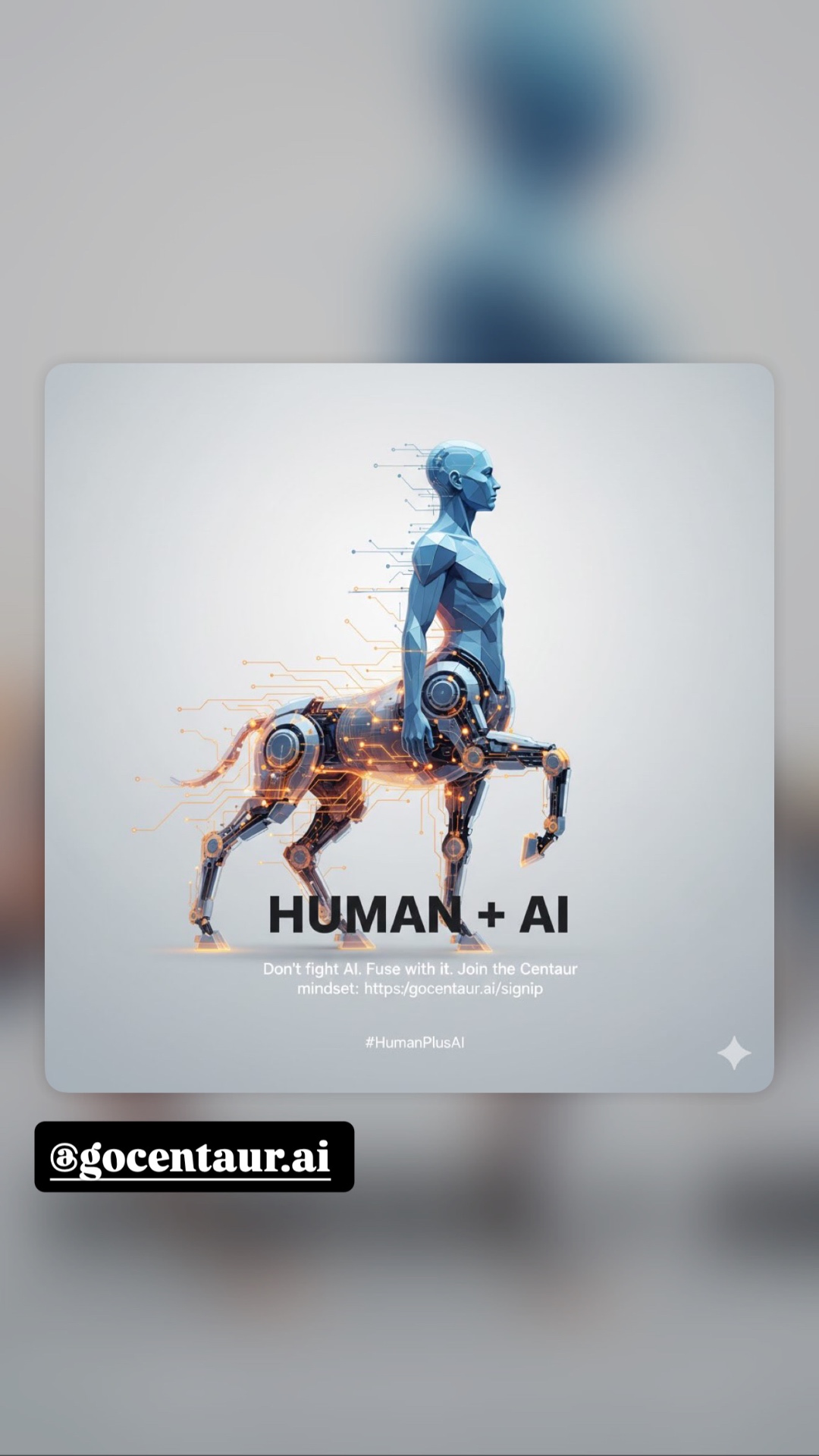
Build yourself into a Centaur?a Centaur.
A personal operating system that helps you think clearly, act with discipline, and grow across work, health, and learning — every day. Most people use AI in fragments — a tool for writing, another for research, another for fitness. Centaurs build a system around themselves. Human intent sets direction. AI provides structure, feedback, and continuity. The result is daily progress that compounds instead of resets.
Define goals and tasks in plain language
Let the system organize execution and priorities
Improve across work, health, and personal growth together
Progress doesn't come from motivation. It comes from structure.
