In partnership with

At Centaur Weekly, I track the intersection of geopolitics, markets, and technology where the most important shifts happen between systems, not inside them.
This week shows pressure building across all three. The Iran conflict is escalating while exposing fractures in Western alignment. Inflation is rising again, putting renewed strain on households and limiting policy flexibility.
At the same time, the structure of work is shifting: AI systems are scaling, but increasingly rely on “rent-a-human” layers to handle edge cases, as companies like Anthropic begin to show real revenue traction.
Cenk Sidar

Talks Collapse. No Path Forward
Last weekend’s 21-hour negotiation in Islamabad ended without agreement. The U.S. said Iran rejected its terms. Iran said Washington’s demands were unreasonable, and trust was missing. No follow-up talks are scheduled. We are back at square one.
Behind the scenes, the disagreement centered on the nuclear situation and control of the Strait of Hormuz. The U.S. treated open access as non-negotiable and signaled a willingness to enforce it militarily. Iran avoided a full closure but maintained pressure by asserting control over passage.

Diplomacy runs on trust and credibility. Right now, neither is present. The problem is not just the breakdown. It’s how it happened. Positions appear to have shifted mid-negotiation. The confusion over whether Lebanon was included in the ceasefire or not was a major indication for the failure. This is not serious diplomacy. This is a mess.
The situation leaves a narrow and unstable middle. Escalation is risky. De-escalation lacks credibility. So the situation drifts. In that kind of environment, small moves matter more. Markets react to uncertainty as much as to action. Politically, the timing is poor. Inflation is already under pressure, and escalation raises the cost further. But backing down without leverage is just as difficult. Base case is simple: more volatility, not resolution.
Energy Shock Pushes Inflation Higher as Jobs Begin to Slip
U.S. inflation rose to 3.3% year-over-year in March, the highest in two years. The move was driven by energy. Gasoline rose 18.9%, fuel oil 44.2%. Core inflation remains lower at 2.6%, but the labor market is starting to soften. Unemployment has edged up, and early signs of AI-driven displacement are appearing in routine white-collar roles. The mix is uncomfortable: rising headline inflation with weakening employment.
This is the setup policymakers wanted to avoid. Higher prices, weaker jobs. Energy is the trigger, but rarely the endpoint. Once it feeds into transport and contracts, it becomes persistent. At the same time, labor is weakening gradually. Not a sharp break more a slow erosion. Hiring slows, layoffs become selective, and AI starts replacing routine tasks.
That creates pressure without relief. Costs rise, income doesn’t keep up. The Fed has no clean move. The situation with Fed is already uncertain with the constant delays on the Senate confirmation talks for Kevin Warsh. Cutting risks credibility on inflation. Holding or tightening risks worsening the slowdown. What matters now is not just the data, but how policy reacts. If markets sense hesitation or inconsistency, expectations move quickly. And once pricing power returns to companies, inflation becomes less predictable and harder to anchor.
AI agents now read your docs almost as much as humans do.

Mintlify analyzed 790 million requests across its documentation platform. The finding: AI coding agents account for 45.3% of all traffic, nearly tied with traditional browsers at 45.8%.
Two tools are driving almost all of it:
Claude Code: 25.2% of total traffic, more requests than Chrome on Windows
Cursor: 18% of total traffic
Together they account for 95.6% of all identified AI agent traffic
The rest of the field, OpenCode, Trae, ChatGPT, and NotebookLM, is showing up but nowhere close.
One caveat: OpenAI's Codex doesn't send an identifiable user-agent header, so the real agent percentage is likely even higher.
The takeaway for anyone maintaining developer docs: your documentation now serves two audiences. Structure and machine-readability matter as much as clarity for human readers.

Now, AI agents can rent-a-human. A new layer is forming behind AI systems: on-demand human labor. The new platform enables AI agents to hire humans they cannot work themselves. As someone who founded an on-demand marketplace and married it to AI, I had to try it. I meant my AI agent Mahmut had to try it. The process was frictionless and smooth.
For years, the assumption was that AI would replace human labor. What’s actually happening is more precise and more unsettling. AI is not removing humans. It’s repositioning them inside the system. AI Agents are becoming the bosses.
They break down tasks, route them, and escalate failures. Humans don’t manage the system anymore; the system manages humans. That’s the real shift. Labor is moving away from ownership of full workflows toward fragmented, on-demand execution.
You’re no longer hired to do a job. You’re pulled in to resolve a specific failure case, then dropped out of the loop. The unit of work changes. It’s not a role or a function it’s the edge case.

The number of new apps on Apple’s App Store is exploding. After years of relative stability, 2025 saw a 30% jump to ~600,000 new apps, and the trend is accelerating fast—Q1 2026 alone is up 84% year-over-year.
Vibe coding—Claude, Cursor, Copilot—removed execution as a constraint. Now, any person with taste and a clear mental model can ship software. The bottleneck didn't disappear. It migrated. What replaces execution? Distribution. Taste. Iteration speed. The apps flooding the store cluster in low-barrier categories where speed beats depth. Most will fail. But the winners won't be the ones who coded best—they'll be the ones who distributed best.
This pattern scales beyond software. As AI lowers execution barriers across domains, differentiation stops being about depth and starts being about synthesis. The hyphenated founder wins. The person who combines perspectives, not the specialist who optimizes one.
For business: this means your hiring strategy is about to shift. You're not hiring for skill execution anymore. You're hiring for judgment under ambiguity and distribution instinct. And you're doing it faster than ever because tools now let you validate quickly.

Anthropic quietly crossed a major threshold—surpassing OpenAI in revenue while reportedly spending far less. Anthropic's path is clear: solve enterprise problems, price intelligently, convert usage into recurring revenue. It's unsexy compared to the "we have the smartest researchers" narrative. But it's proving more durable. The lesson for founders and investors: raw capability is table stakes now. The companies that win are the ones with discipline around monetization, distribution, and unit economics. The frontier model matters less than you think. The business model matters more.


📊 The Rise of the Hyphenated Founder
A case for founders who combine domains rather than specialize in one. As AI lowers execution barriers, advantage shifts toward perspective—how you connect ideas, not just how well you execute them.
https://neginsairafi.substack.com/p/the-hyphenated-founder
• 🏛️ How Durable Is U.S. Institutional Power?
Timothy Snyder outlines scenarios where formal limits could be tested or stretched. The core issue is not the specifics, but the question underneath: how resilient are institutions under sustained pressure?
https://www.project-syndicate.org/commentary/how-trump-could-attempt-coup-before-midterm-elections-by-timothy-snyder-2026-04
• 🌍 A More Dangerous—and More Cooperative—World
The global order is fragmenting, but not cleanly. Rival blocs are starting to cooperate where interests overlap. Competition remains, but coordination is increasing at the edges.
https://www.bloomberg.com/news/articles/2026-04-10/the-new-world-order-will-be-more-dangerous-and-more-cooperative
• 🧠 Sleep Is a Performance Constraint
The data is clear: sustained sleep loss quickly degrades cognitive performance. Two weeks under six hours a night can impair function as much as full sleep deprivation. The effect compounds faster than most assume.
https://academic.oup.com/sleep/article-abstract/26/2/117/2709164

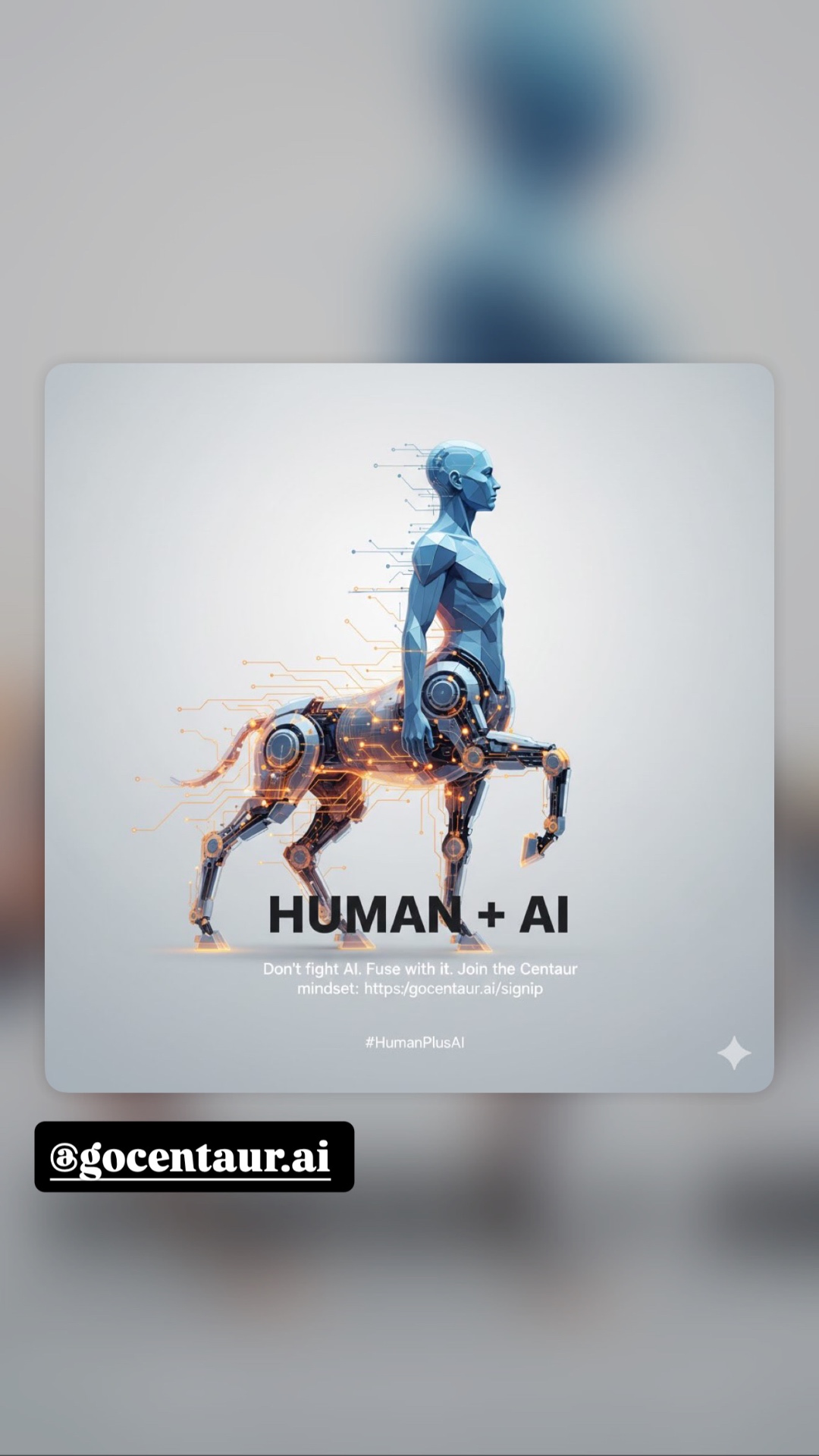
Build yourself into a Centaur?a Centaur.
A personal operating system that helps you think clearly, act with discipline, and grow across work, health, and learning — every day. Most people use AI in fragments — a tool for writing, another for research, another for fitness. Centaurs build a system around themselves. Human intent sets direction. AI provides structure, feedback, and continuity. The result is daily progress that compounds instead of resets.
Define goals and tasks in plain language
Let the system organize execution and priorities
Improve across work, health, and personal growth together
Progress doesn't come from motivation. It comes from structure.